The Modified Wheel: Cash-Secured Puts, Covered Calls, and a LEAP After the Drop
The classic wheel is an income loop: sell a cash-secured put, take the shares if you are assigned, sell covered calls, and start over if those shares are called away. This version keeps that loop on liquid ETFs — QQQ, SPY and IBIT — and adds one extra step after a drop. Once assignment has filled and the range has settled, you buy a deep in-the-money LEAP call (about 80 delta, about two years out) as a separate upside overlay, then keep writing covered calls on the shares you already own.
Track the covered-call leg after you own the shares. The Covered Call & PMCC Tracker stores a ledger in your browser only, with today’s short-call reads on SPY, QQQ and IBIT.
Open the Covered Call & PMCC Tracker → Expected move calculatorBuy the Dip appHow this differs from the classic wheel
On the classic wheel you are paid to wait, then paid again to hold. The trade-off is familiar: covered calls cap the upside of the shares. If a strong rebound comes after you were assigned, a short call can take the stock away just as the recovery gets going, and you have to rebuild the position from scratch.
The modification is not a different put or a different call. It is a second long after the dust settles — a high-delta LEAP that keeps participating if the ETF climbs, including after a later covered call takes the shares. You still collect put premium and call premium. You still only buy shares at a strike you chose, reduced by the credits you already took in. You do not have to deploy the full capital of another 100 shares to add that extra upside.
It is also not a signal to sell any particular strike today. The rules below are the process; the fills are yours.
The strategy flowchart
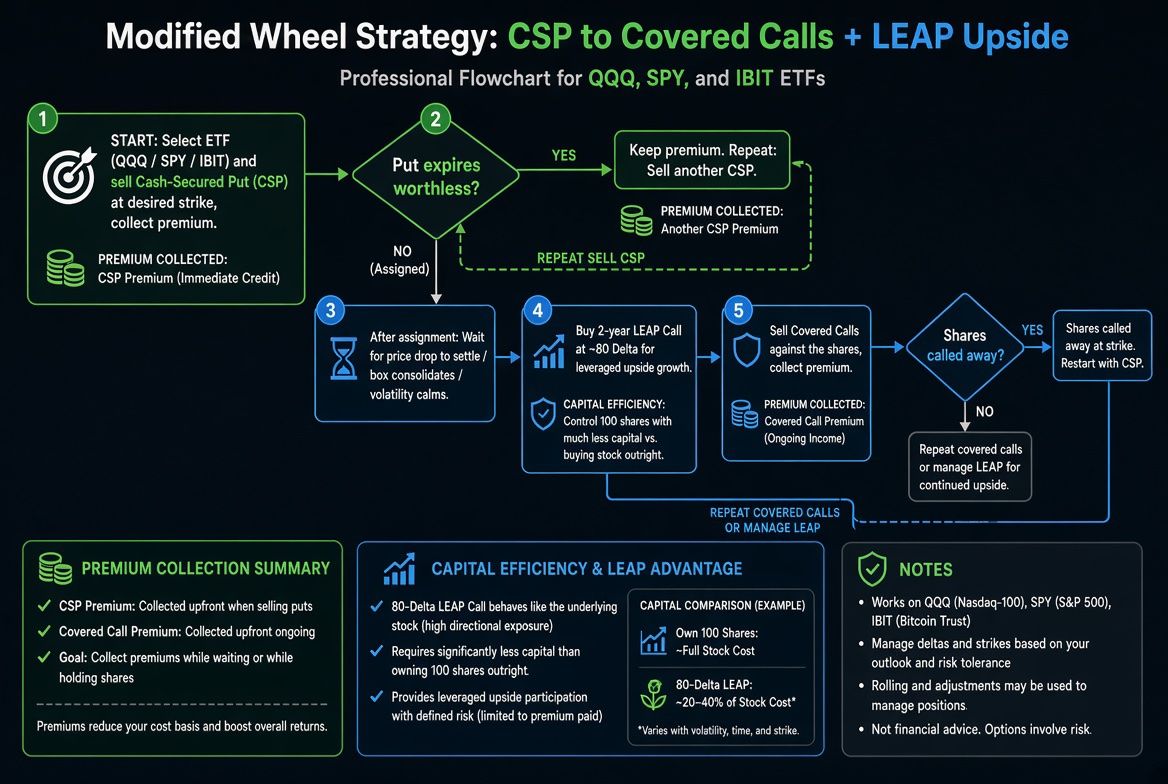
1. Select an ETF and sell a cash-secured put
Start with an underlying you are willing to hold and that trades a deep options market. QQQ, SPY and IBIT fit that test: tight markets, plenty of expirations, and enough open interest that a short put or short call is not fighting the spread — the same reason I favor liquid index and IBIT options in general.
Sell one cash-secured put at a strike you would be glad to own. The cash you set aside is the assignment bill: 100 shares times the strike. In return you collect a premium up front.
A common preference rule — not a recommendation of any listed strike — is to sell a 10- to 20-delta put. That usually sits far enough below the market that assignment is the exception, and close enough that the strike is still a price you actually want. Many traders also line the strike up with a level they already planned to buy on the Buy the Dip ladder, or outside the expected move (cash-secured puts as paid dip-buy orders walks through that comparison) and why selling outside the expected move matters.
If you would not want 100 shares at that strike after a drop, do not sell the put. The premium is compensation for a buy order you already accept, not a reason to accept a price you dislike.
2. What happens to the put
Two outcomes at expiration (early assignment on these American-style ETF puts is possible, but uncommon while meaningful time value remains):
- The put expires worthless. You keep the premium. The cash collateral is still free. Sell another cash-secured put and repeat the first step.
- You are assigned. You buy 100 shares at the strike. Your effective cost basis is the strike minus every premium you have collected on the way in — this put and any earlier puts on the same wheel unit. That discounted basis is the number you will use later when you choose covered-call strikes.
Assignment is not a failure of the wheel. It is the other intended result: you wanted the shares at that price, and you were paid to wait.
3. After the drop, wait for the box to settle
If you were assigned, the ETF has usually already fallen — that is why the put finished in the money. The next mistake is to treat assignment as a green light to buy more upside immediately.
A deep in-the-money LEAP tracks the ETF closely. Bought into continuing weakness, it will keep losing value if the slide is not over, and implied volatility after a drop is often still high (so you pay more for the same delta). The rule here is to pause. Let the price stabilize, let a range form — the “box” on the chart — and let volatility calm down before you add the LEAP.
That pause is judgment, not a countdown. There is no official number of days or ATR multiples that makes the box “settled.” You are trying to avoid buying the long call while the decline is still unfolding. If the ETF is still making lower lows and implied vol is still expanding, wait. If the range has tightened and the tape looks less forced, the overlay is at least no longer being purchased into a free fall.
4. Buy a 2-year, about 80-delta LEAP
Once that range has settled, buy a deep in-the-money LEAP call — roughly 80 delta, roughly two years from today (in practice, the January LEAPS expiration nearest that horizon, when it is listed).
- It behaves a lot like the shares. High delta means the call participates in most of the ETF’s move, up or down, rather than acting like a lottery ticket.
- It typically uses a fraction of the capital of another 100 shares. A roughly 80-delta, two-year call often costs on the order of 20–40% of buying 100 shares outright. That is a typical, illustrative range, not a quote from any particular chain or date. The share depends on implied volatility, interest rates, dividends and the exact strike. SPY-like volatility tends to sit toward the lower end; a higher-volatility name such as IBIT tends toward the higher end, because more of the premium is time value.
You already own the shares from the wheel. The LEAP is extra, leveraged participation on top of that lot — not a replacement for it. At the moment you buy an 80-delta call against a 100-share position, your combined directional exposure is about 1.8 times one lot of shares (1.00 from the stock plus about 0.80 from the call). That is the point of the overlay, and it is also the risk: further declines now hit both legs.
After you own it, watch delta, theta and remaining time. If you want to maintain the overlay, you can roll to a later-dated, about-80-delta call when this one shortens or drifts away from that delta. Rolling can realize a gain or a loss; it is maintenance, not magic — covered calls vs poor man’s covered calls covers how I think about LEAPS delta and time.
5. Keep the wheel going with covered calls
With 100 shares in hand, go back to income: sell out-of-the-money covered calls against those shares and collect more premium.
The strike rule is simple and is not a ticker-specific idea: sell calls above your purchase price — more precisely, above your effective cost basis (the assignment strike minus premiums already collected). Writing calls below that basis is how wheel traders lock in an unforced loss if they are called away.
- The call expires worthless. You keep the premium. The shares (and the LEAP) are still yours. Sell another covered call.
- The shares are called away. You deliver the 100 shares at the short-call strike. You realize the gain or the reduced loss on the shares, plus every premium along the way, and you can restart the wheel by selling a new cash-secured put. The LEAP does not get called away with the shares. It remains as separate long-term upside exposure.
Log the share-and-call part of this the same way you would log any covered call — the Covered Call & PMCC Tracker keeps a browser-only ledger on SPY, QQQ and IBIT (covered call vs PMCC).
Illustration, not a trade ticket. Nothing in this article is a recommendation to buy or sell a listed strike, expiration or size today. Deltas, the 20–40% capital range and the combined ~1.8 share-equivalent exposure are typical framing so you can see how the pieces fit, not forecasts or current quotes. Always read the live chain.
How this compares with a poor man’s covered call
A poor man’s covered call (PMCC) replaces the 100 shares with a deep in-the-money LEAP and then sells shorter-dated calls against that LEAP. It is a long call diagonal: less capital than stock, more path risk, no dividends, and a messier assignment (a short call that is assigned leaves you short 100 shares against the long LEAP).
This modified wheel does the opposite of a replacement. You keep the assigned shares, you sell covered calls against the shares, and you buy a LEAP in addition. Dividends on SPY or QQQ, if any, still accrue to the shares. Early assignment of the short call is the ordinary covered-call problem (you lose the shares at the strike), not a PMCC assignment problem. IBIT typically does not pay a regular dividend, so that particular early-exercise pressure is smaller there, but its options are still American-style — see SPX vs SPY on settlement and assignment for how ETF options differ from cash-settled index options and Bitcoin vs bitcoin ETFs if the underlying is IBIT.
Use a PMCC when you want stock-like exposure without buying the shares. Use this overlay when you already own the shares from the wheel and want extra upside that can survive being called away.
Why add the LEAP overlay
- Income at every stage. Cash-secured-put premiums while you wait, covered-call premiums after you own the shares.
- A defined entry. You only buy the ETF at a strike you chose, and the credits you collected reduce that basis.
- An upside overlay after the drop. The ~80-delta LEAP adds leveraged participation once the range has settled, without buying another full 100 shares. If a later covered call takes the stock, the LEAP is still there.
- Capital efficiency on the extra long. The put uses cash collateral (then that cash becomes the shares). The LEAP typically uses far less additional capital than a second lot of stock for a similar slice of directional exposure — again, a typical range, not a live quote.
- It belongs on liquid names. QQQ, SPY and IBIT are the point: you need room to pick a put, a LEAP and a covered call without paying away the edge in the spread.
Practical notes and my rules
- Only sell a put at a strike you want to own. A 10- to 20-delta put is a common way to frame that, not a standing order on any ticker.
- Fully cash-secure the put. If assignment hits, you can pay for the shares without disturbing the rest of the account (bankroll and +EV).
- Do not buy the LEAP into a still-falling tape. Wait for the box — a calmer range and quieter volatility — before adding the 80-delta call.
- Treat the 20–40% capital figure as an illustration. Check the live LEAPS chain; higher implied volatility costs more as a share of the stock.
- Sell covered calls above your effective cost basis. Out of the money, and above what you would be unhappy to sell the shares for.
- Remember the extra downside. Shares plus an 80-delta LEAP start near 1.8 times the exposure of the shares alone. A further decline hits both.
- Watch the LEAP and roll if you want to keep it. Delta, theta and time left will drift. Rolling is optional maintenance.
- Size the whole stack. Do not start the cash-secured put unless assignment and a later LEAP purchase both fit the same capital and risk plan.
- Stay with liquid underlyings such as QQQ, SPY and IBIT, and match strikes and expirations to your own thesis — not to a headline.
This is still a long-biased income strategy. Significant further declines hurt the shares and the LEAP together. Time decay hurts the LEAP if the ETF chops sideways for months. Covered calls still cap the upside of the shares (though not of the LEAP). None of those are bugs in the design; they are the cost of collecting premium and adding leverage after a drop.
LEAPS (Long-term Equity AnticiPation Securities) are listed longer-dated options, typically on the January cycle, with expirations that can run a couple of years out. QQQ, SPY and IBIT options are American-style and settle into shares, so short calls can be assigned any day, most often when they are deep in the money with little time value left — especially around an ex-dividend date on dividend-paying ETFs such as SPY and QQQ. Deltas move as the ETF and implied volatility move; “about 80 delta” is a target, not a pin. The 20–40% capital comparison is a typical illustration from option pricing (deep in-the-money long-dated calls are mostly intrinsic value plus some time value), not a measurement from a backtest file.
FAQ
What is the modified wheel strategy?
It is the classic options wheel with an extra growth overlay after assignment. You sell a cash-secured put on a liquid ETF such as QQQ, SPY or IBIT. If the put expires, you keep the premium and sell another. If you are assigned, you own 100 shares, wait for the decline to settle, buy a deep in-the-money LEAP call (about 80 delta, about two years out), and then sell out-of-the-money covered calls against the shares. The LEAP is a separate long-term upside position.
How is this different from the classic wheel?
The classic wheel stops at cash-secured puts and covered calls: collect premium, take assignment, write calls, and restart if the shares are called away. This version keeps that income loop and, after the drop has settled, adds a high-delta LEAP so you still have leveraged upside if the ETF recovers — even if a later covered call takes the shares away.
How is this different from a poor man’s covered call?
A poor man’s covered call replaces the 100 shares with a LEAP and sells shorter-dated calls against that LEAP. Here you keep the assigned shares and sell covered calls against those shares. The LEAP sits on top as an extra long call, not as a substitute for the stock. If the shares are called away, the LEAP remains; in a PMCC, assignment of the short call is a problem you have to unwind against the LEAP itself.
What strike should I sell for the cash-secured put?
Pick a strike you are actually willing to own, not the one with the fattest premium. A common starting rule is a 10- to 20-delta put — far enough out of the money that assignment is the exception, close enough that you would be glad to buy the ETF there. That is a preference rule, not a recommendation of any strike on today’s chain.
Why wait after assignment before buying the LEAP?
Assignment usually happens after a drop (the put finished in the money). A high-delta LEAP bought into continuing weakness will keep losing value if the ETF slides further, and implied volatility is often still elevated. Waiting for a “box” — a tighter range, calmer swings, quieter volatility — is a judgment pause so you are not adding leveraged long exposure while the decline is still unfolding. It is not a fixed number of days.
Why a two-year, about 80-delta LEAP?
Around 80 delta, the call is deep in the money, so it behaves more like the shares (high participation on the upside) and carries less spare extrinsic value than an at-the-money call. About two years of time slows daily decay and leaves room to recover if the ETF wobbles again. You can roll it later if you want to keep the overlay. Exact listed expirations are the January LEAPS cycle nearest that horizon when they are available.
How much capital does the LEAP take compared with more shares?
A deep in-the-money, roughly 80-delta call with about two years to expiration often costs on the order of 20–40% as much as buying another 100 shares. That is a typical, illustrative range, not a quote from any particular chain. It moves with implied volatility, rates, dividends and the exact strike: calmer names such as SPY tend toward the lower end; a higher-volatility name such as IBIT tends toward the higher end because more of the premium is time value.
What happens if the covered call is assigned?
Your 100 shares are called away at the short-call strike. You keep every premium collected along the way (the original put, any later puts, and the covered-call credits) and you realize the gain or reduced loss on the shares versus your effective cost basis. Then you can restart the wheel by selling a new cash-secured put. The LEAP is unchanged: it stays as separate long-term upside.
What are the main risks?
This is still a long-biased income strategy. A further decline after assignment hurts the shares almost dollar-for-dollar and hurts the LEAP as well (you added roughly 0.80 of extra share-equivalent exposure). The LEAP can also lose value from time decay if the ETF goes sideways. Short American-style calls on SPY and QQQ can be assigned early, especially around ex-dividend dates. Size the cash-secured put only if assignment and a later LEAP purchase both fit your capital plan.
Is this financial advice?
No. It is education from my own process. Options involve substantial risk and are not suitable for all investors.
Log covered calls and PMCCs without creating an account. The Covered Call & PMCC Tracker stores a ledger in your browser only, with today’s short-call reads on SPY, QQQ and IBIT.
Open the Covered Call & PMCC Tracker → Expected move calculatorBuy the Dip app